
Headache & Migraine Structural Evaluation in Greensburg, PA
Not all headaches are the same, and not all come from the neck. We objectively evaluate whether measurable cervical and postural findings may be contributing to your headache pattern—and whether conservative structural care is a reasonable option for you.
Schedule a Complimentary Structural ConsultationWhat We Actually Evaluate
Headache is complex. Our role is not to claim a single cause, but to measure your cervical structure and posture and determine whether they may be contributing to your specific presentation. Some headaches respond to addressing the neck; many do not. We help you understand which category you are likely in.
Migraine, Tension-Type, and Cervicogenic Headache Are Not the Same Thing
- •Migraine is a primary neurological disorder with genetic, neurological, and vascular components and common triggers. It is not caused by the neck, though neck symptoms can accompany it.
- •Tension-type headache is a common primary headache, often linked to muscle tension and posture (see tension headaches).
- •Cervicogenic headache is a secondary headache referred from structures in the upper neck. This is the type where evaluating and addressing the cervical source is most relevant, and where conservative care is recognized as a first-line approach.
These overlap, and telling them apart can be genuinely difficult—overlapping features do not by themselves prove the neck is the cause. Part of a careful evaluation is judging which factors are plausibly involved in your headaches.
Our Role in Your Care
Our role is to determine whether measurable structural findings may be contributing to your presentation. If they are, we explain what we found, what conservative care may reasonably accomplish, and how we will objectively reassess progress. If they are not, we’ll tell you that too.
Common Symptoms and Presentations
Headache presentations we evaluate commonly include:
- • Pain that begins in the neck or base of the skull
- • One-sided or band-like head pain
- • Reduced neck movement and associated neck or shoulder tension
- • Symptoms aggravated by sustained posture or neck position
What Can Contribute
Headache can involve neurological, vascular, hormonal, genetic, medication-overuse, sleep, and cervical or postural factors. A finding on an examination or X-ray—such as reduced cervical curve or forward head carriage—is a potential contributor, not automatically the cause of your headaches.
The Structural Connection
Loss of the normal cervical curve (loss of cervical lordosis) and forward head posture increase mechanical load on the neck and may contribute to neck-related and cervicogenic headache and to tension-type symptoms. Where measurable cervical findings are present and plausibly related, conservative structural care may help address that contributor. We do not claim to treat the underlying neurological mechanism of migraine.
Could Your Headache Have a Cervical Component?
Features that make a cervical contribution more likely include:
- • Headaches that begin in the neck
- • Reduced cervical range of motion
- • Symptoms aggravated by sustained posture
- • A history of whiplash or neck injury
- • Forward head posture
- • Associated neck stiffness
If these features are absent, a structural cervical cause becomes less likely, and a different evaluation may be more appropriate for you.
What Optimus Spine & Posture Measures
Every patient is different. Our goal is not simply to determine what hurts, but whether measurable cervical structure and posture are contributing to your presentation—the distinction that determines whether structural correction is an appropriate part of your care.
- •History and examination: your headache pattern plus orthopedic and neurological testing.
- •Posture and cervical range of motion: objective posture assessment—why objective measurement matters.
- •Radiographs when clinically indicated: to measure cervical curvature and alignment in degrees—see our structural X-ray analysis.
- •Objective reassessment: we re-measure over the course of care so progress is tracked, not assumed.
The Conservative Structural Approach
When a case is appropriate, a plan may include some—not all—of the following, chosen for the individual. Conservative care of this kind is a recognized first-line approach for cervicogenic headache; for primary migraine it is supportive, not a cure.
- •Specific chiropractic adjusting selected for the individual case.
- •Cervical extension traction designed to improve measurable cervical alignment.
- •Posture retraining and exercise to reduce mechanical load on the neck.
- •Objective reassessment to review response and adjust the plan.
An Individual Case: Cervical Curve Before and After
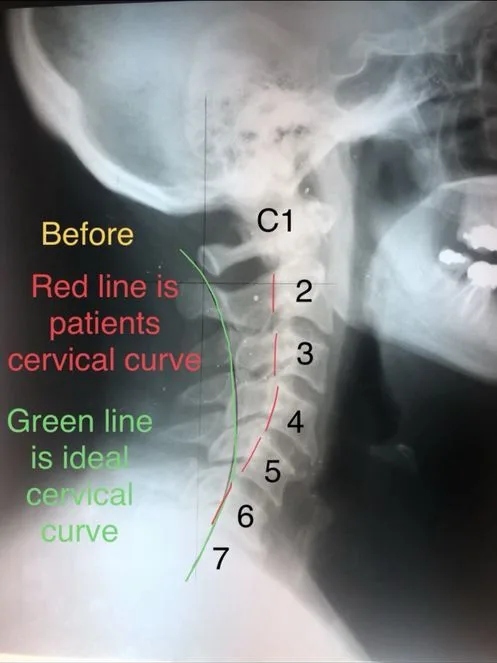
Reduced Curve (Red Line)
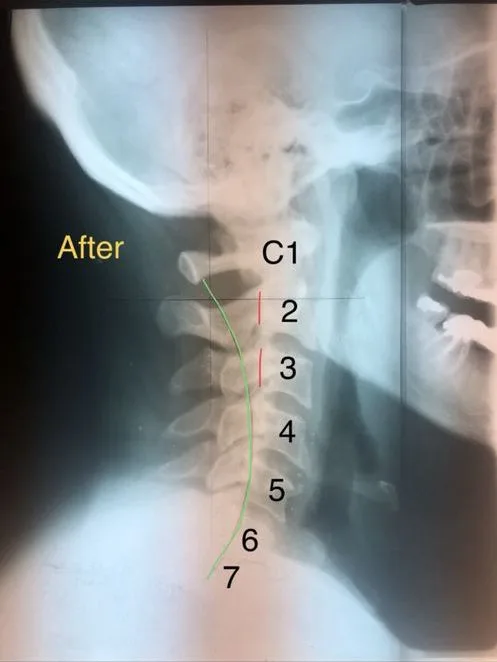
Improved Curve (Green Line)
These images show cervical curve assessment in one de-identified individual case, illustrating how we measure alignment. This is not a guaranteed or typical outcome. Individual results vary; measurements are case-specific and do not predict another person’s result.
See more documented results.
What This Care Can and Cannot Claim
Migraine is a complex neurological disorder. Our role is to determine whether measurable cervical and postural findings may be contributing to your presentation and whether conservative structural care is an appropriate part of your overall management.
We can objectively evaluate and, when appropriate, work to improve measurable cervical alignment and address cervicogenic or tension-type contributors. We cannot cure migraine, guarantee headache resolution, or prevent future headaches.
When appropriate, we encourage patients to continue working with their primary-care physician or neurologist as part of comprehensive migraine management.
Who May Be a Candidate
A structural evaluation is often reasonable for neck-related or cervicogenic-pattern headaches, tension-type headaches, and forward-head-posture presentations, when there are no urgent findings. The only way to know is a clinical evaluation.
Who May Not Be a Candidate
Some presentations are better served elsewhere first—for example, primary migraine seeking a cure, cluster headache, or any of the urgent findings below. Not every headache is appropriate for chiropractic care, and we’ll tell you directly if yours is not.
When to Seek Urgent Medical Care
Some headaches need prompt emergency evaluation rather than routine care. Seek medical attention right away for:
- • A sudden, severe “worst-ever” (thunderclap) headache, or one that wakes you from sleep
- • Headache with fever and a stiff neck
- • A new neurological deficit (weakness, slurred speech, vision loss, confusion)
- • A new or clearly changed headache after age 50, or with a cancer history
- • Headache after significant head trauma
These can signal a stroke, aneurysm, meningitis, or other serious condition. This is general guidance, not a self-diagnostic checklist—when in doubt, seek medical care.
What People Commonly Try
Most people arrive having already tried at least one of these. Each has a legitimate place, and for many people with migraines one of them is the right answer. The question is whether anything structural has been measured along the way.
Over-the-counter or prescribed medication
Where it helps: Can reduce pain and inflammation enough to keep you moving and sleeping, which matters. Its appropriate use is a conversation with your physician.
Its limit: It is aimed at the symptom rather than at any structural or mechanical finding, so it does not change what is measured.
Medical referral and evaluation
Where it helps: Essential when there are red flags, progressive neurological findings, or a possible non-mechanical cause. We refer to the appropriate physician when the examination points that way.
Its limit: A medical opinion is a diagnosis, not a plan; it does not by itself tell you what the structure is doing or how to change it.
Physical therapy
Where it helps: Strengthening, mobility and movement retraining with a qualified professional. Many people do well with it.
Its limit: Whether structural alignment is measured and re-measured varies by provider; progress is often judged mainly by symptoms and function.
Massage and soft-tissue work
Where it helps: Relieves muscle tension and can feel much better for a time.
Its limit: If a loading pattern keeps asking the same muscles to compensate, the tension tends to return.
Chiropractic care aimed at relief
Where it helps: Often effective for its goal of reducing pain and improving how you move, and sometimes all a person needs.
Its limit: Progress is usually judged by symptoms, and structural measurement is not always part of the process.
None of this is an argument against those options. It is the reason we measure before recommending anything. How relief-focused care and structural correction differ.
How Optimus Approaches the Evaluation
The process is the same for migraines as for any presentation we see, because it is designed to find out whether structure is part of your problem rather than to assume it is.
Complimentary Structural Consultation
A private conversation about your concerns, goals, previous care and whether this office is an appropriate fit. No examination, imaging or treatment takes place.
Paid structural examination
Orthopedic, neurological, movement and functional testing. The fee is explained before it is scheduled.
Objective measurements
Posture measured in millimeters and compared with normal reference values, so there is a baseline to re-measure against.
Imaging only when clinically warranted
Structural X-rays or stress views are taken only when the examination indicates them, and the reason is explained first.
Patient Recommendation Conference
The separate visit where your findings, our recommendations, the proposed plan and the fees are explained before you agree to anything.
Individualized recommendations
If structural correction is appropriate, a plan built around your own measured findings. If another evaluation is the better path, we say so.
Scheduled progress examinations
Re-examination at set points so change is documented, not assumed. If the measurements are not changing, the approach changes.
Comparative imaging only when clinically justified
Repeat images are taken to compare against the baseline only when there is a clinical reason to do so.
What the first visits involve, what to bring and how payment works are set out on the new patient page.
Not Sure Whether This Applies to You?
The complimentary structural consultation is the place to ask. It is a private conversation about your migraines, what you have already tried and whether measuring your spine is a reasonable next step. No examination, imaging or treatment takes place, nothing is booked beyond it, and if another kind of evaluation is the better path we will say so.
Schedule a Complimentary Structural ConsultationFrequently Asked Questions
Can a chiropractor cure migraines?
No. Migraine is a primary neurological disorder, and we do not cure it. What we can do is objectively evaluate whether cervical structure and posture may be contributing to your headache pattern, and whether conservative structural care is a reasonable part of your overall management. Individual results vary.
What is the difference between a migraine and a cervicogenic headache?
Migraine is a primary neurological disorder that is not caused by the neck. A cervicogenic headache is a secondary headache referred from structures in the upper neck. Tension-type headache is another primary headache often linked to muscle tension and posture. The types overlap and can be difficult to tell apart, so overlapping features do not by themselves prove the neck is the cause.
Do you take X-rays for headaches?
Only when clinically indicated. When appropriate, radiographs let us measure cervical curve and alignment objectively, so we can see whether a measurable structural finding may be contributing to your presentation.
Will addressing my neck stop my headaches?
It may help the cervicogenic and cervical or tension-type components of a headache pattern — conservative care of this kind is a recognized first-line approach for cervicogenic headache. It is not a guaranteed or universal solution, and it does not treat the underlying mechanism of migraine. Individual results vary.
When should I seek urgent medical care for a headache?
Seek prompt emergency evaluation for a sudden, severe 'worst-ever' (thunderclap) headache; a headache with fever and a stiff neck; a new neurological deficit such as weakness, slurred speech, vision loss, or confusion; a new or clearly changed headache after age 50 or with a cancer history; or a headache after significant head trauma.
Research and References
Educational information on this page is consistent with the following authoritative references, which support headache classification and the recognized role of conservative care for cervicogenic headache—not proof of any specific outcome.
- Pescador Ruschel MA, De Jesus O. Migraine Headache. StatPearls [Internet]. StatPearls Publishing; 2024. ncbi.nlm.nih.gov (peer-reviewed clinical reference)
- Al Khalili Y, Ly N, Murphy PB. Cervicogenic Headache. StatPearls [Internet]. StatPearls Publishing; 2022. ncbi.nlm.nih.gov (peer-reviewed clinical reference)
- International Headache Society. ICHD-3, 11.2.1 Cervicogenic headache. ichd-3.org (headache classification)
Related Reading
Learn more about Dr. Gareth Bury, DC.
Individual results vary. A clinical evaluation is required to determine candidacy for structural correction. Outcomes depend on factors including severity, chronicity, adherence, and overall health.