
Scoliosis Evaluation and Structural Care in Greensburg, PA
Scoliosis care should start with accurate measurement and honest guidance. We objectively assess your curve and posture, explain what we find, and help you understand your options—working alongside, not in place of, your medical and orthopedic care.
Schedule a Complimentary Structural ConsultationWhat Scoliosis Is
Scoliosis is a three-dimensional spinal deformity that includes a measurable lateral curve and vertebral rotation. On standing radiographs, a Cobb angle of 10 degrees or greater meets the conventional radiographic definition. Not every curve is clinically equivalent—magnitude, curve pattern, growth remaining, documented progression, symptoms, and the underlying cause all matter.
Adolescent and Adult Scoliosis Are Different
Adolescent scoliosis and adult degenerative scoliosis require different evaluation and management pathways.
- • In adolescents, the central concern is growth-related progression, guided by curve size, skeletal maturity, and whether the curve is documented to be progressing.
- • In adults, care more often focuses on pain, function, balance, spinal stenosis, degeneration, neurological symptoms, bone health, and change over time.
We do not apply adolescent bracing or growth-based reasoning to adults, or vice versa.
What We Evaluate
We evaluate adolescent idiopathic scoliosis and adult degenerative scoliosis. We also evaluate postural asymmetry and potentially nonstructural curves, which must be distinguished from structural scoliosis—they are not automatically the same thing, and telling them apart changes the plan.
How Scoliosis Is Measured and Monitored
The Cobb angle is the standard measurement. Because curves can change—especially during growth—appropriate monitoring over time is a legitimate, evidence-based part of scoliosis care, not a failure to act. When imaging is clinically indicated, existing and follow-up radiographs may be used to measure the Cobb angle and monitor change; we review prior imaging whenever available and coordinate follow-up imaging appropriately, rather than repeating it unnecessarily. Small differences between radiographs must be interpreted cautiously, because positioning and Cobb-angle measurement variability can affect the result—so a few degrees of difference is not automatically true structural change.
Example: How the Cobb Angle Is Measured
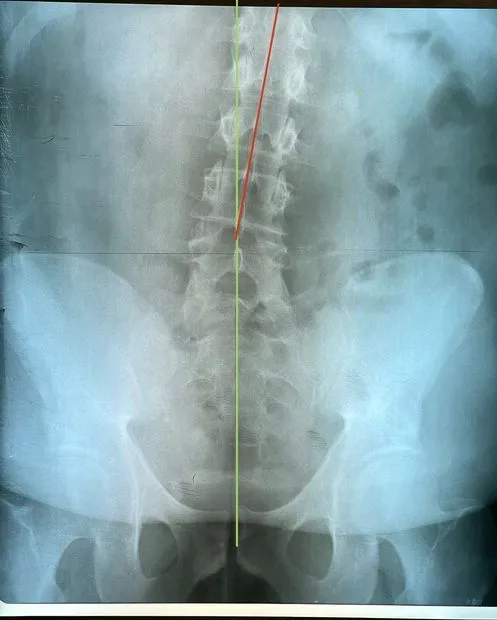
This image illustrates how the Cobb angle is measured on a standing radiograph. It is an educational example of the measurement technique, not a treatment result or documented clinical outcome.
The Care Pathway—General Ranges, Not Rigid Rules
For scoliosis, care is commonly discussed in terms of observation, bracing, and surgery. General magnitude ranges are often cited, but recommendations depend on curve magnitude, skeletal maturity, documented progression, curve pattern, age, symptoms, and the treating specialist’s judgment—not a single Cobb-angle cutoff. For appropriately selected, skeletally immature patients with adolescent idiopathic scoliosis, bracing has strong evidence for reducing the risk of progression toward the surgical threshold, with greater benefit associated with longer daily brace wear. Larger or progressing curves may warrant surgical evaluation.
Our Role in Your Care
Our role is not to replace evidence-based orthopedic management. Conservative structural care is intended to complement appropriate medical and orthopedic management when clinically appropriate. We provide objective measurement, posture- and function-focused conservative care, and reassessment— coordinated alongside your medical, orthopedic, bracing, and scoliosis-specific rehabilitation care. Recognized evidence-based nonoperative care (as described by organizations such as SOSORT) includes observation, bracing, and scoliosis-specific rehabilitation; our contribution is objective measurement and posture-focused care within that bigger picture.
What Optimus Spine & Posture Measures
We do not promise outcomes; we measure your curve and posture objectively and track change over time so decisions are based on findings.
- •History and examination: plus posture assessment and, where relevant, screening for progression risk factors.
- •Radiographs when clinically indicated: to measure the Cobb angle and alignment—see our structural X-ray analysis and why objective measurement matters.
- •Objective reassessment: tracked over time and interpreted with measurement variability in mind.
The Conservative Structural Approach
When appropriate, a plan may include some—not all—of the following, chosen for the individual and coordinated with your other care:
- •Specific chiropractic adjusting and posture-focused care.
- •Mirror Image® methods and traction designed to address posture and measurable alignment.
- •Conditioning and scoliosis-specific exercise; co-management with a bracing provider when a patient is braced.
- •Objective reassessment to review response and adjust the plan.
Conservative care of this kind may help posture, symptoms, function, and conditioning. It is not a substitute for medically indicated bracing or surgery, and it cannot be promised to straighten a curve or stop progression.
What This Care Can and Cannot Claim
We can objectively measure your curve and posture, provide posture- and function-focused conservative care when appropriate, and help you navigate your options with your other providers. We cannot cure scoliosis, straighten a structural curve on demand, or guarantee that a curve will not progress. No conservative treatment reliably “cures” scoliosis; the strongest evidence for limiting progression in growing patients is bracing, which is managed medically.
Who May Be a Candidate
A structural evaluation is often reasonable for adults seeking posture- and function-focused conservative care and objective monitoring, for smaller or postural presentations, and for patients who want objective measurement or a second opinion.
Who May Not Be a Candidate
Some presentations need medical or orthopedic evaluation first—for example, growing adolescents with moderate-to-large or progressing curves, and large curves at any age. Not every scoliosis is appropriate for chiropractic care, and we’ll say so directly.
When to Seek Medical or Specialist Evaluation
For children and adolescents:
- • A curve documented to be progressing during growth, or a large curve
- • Scoliosis in a young or rapidly growing child, or night-time back pain in a child
- • Any new neurological symptoms — seek orthopedic evaluation promptly
For adults:
- • New or progressive neurological symptoms (leg weakness or numbness)
- • Bowel or bladder changes, or symptoms suggesting spinal stenosis
- • Significant new or worsening pain, or breathing difficulty with a severe curve
This is general guidance, not a self-diagnostic checklist—when in doubt, seek medical care.
What People Commonly Try
Most people arrive having already tried at least one of these. Each has a legitimate place, and for many people with scoliosis one of them is the right answer. The question is whether anything structural has been measured along the way.
Observation and repeat imaging
Where it helps: Reasonable for mild findings: watching whether anything changes before acting on it.
Its limit: Waiting is only useful if something is actually being measured at each check.
Bracing
Where it helps: Has a defined role in some growing patients and some curve patterns, under appropriate medical supervision.
Its limit: It is not appropriate for every curve or every age, and it does not replace measurement of how the spine is changing.
Exercise and stretching
Where it helps: Among the most strongly supported options for many spinal conditions, and part of most good plans, including ours.
Its limit: A general programme is not matched to measured findings, so if a structural finding is present it can strengthen around it without addressing it.
Medical referral and evaluation
Where it helps: Essential when there are red flags, progressive neurological findings, or a possible non-mechanical cause. We refer to the appropriate physician when the examination points that way.
Its limit: A medical opinion is a diagnosis, not a plan; it does not by itself tell you what the structure is doing or how to change it.
Surgery
Where it helps: The right answer for specific presentations, including progressive neurological deficit, instability, or a problem that conservative care cannot address.
Its limit: Most people with this condition do not need it, and a careful trial of conservative care is usually appropriate first where it is safe to do so.
None of this is an argument against those options. It is the reason we measure before recommending anything. How relief-focused care and structural correction differ.
How Optimus Approaches the Evaluation
The process is the same for scoliosis as for any presentation we see, because it is designed to find out whether structure is part of your problem rather than to assume it is.
Complimentary Structural Consultation
A private conversation about your concerns, goals, previous care and whether this office is an appropriate fit. No examination, imaging or treatment takes place.
Paid structural examination
Orthopedic, neurological, movement and functional testing. The fee is explained before it is scheduled.
Objective measurements
Posture measured in millimeters and compared with normal reference values, so there is a baseline to re-measure against.
Imaging only when clinically warranted
Structural X-rays or stress views are taken only when the examination indicates them, and the reason is explained first.
Patient Recommendation Conference
The separate visit where your findings, our recommendations, the proposed plan and the fees are explained before you agree to anything.
Individualized recommendations
If structural correction is appropriate, a plan built around your own measured findings. If another evaluation is the better path, we say so.
Scheduled progress examinations
Re-examination at set points so change is documented, not assumed. If the measurements are not changing, the approach changes.
Comparative imaging only when clinically justified
Repeat images are taken to compare against the baseline only when there is a clinical reason to do so.
What the first visits involve, what to bring and how payment works are set out on the new patient page.
Not Sure Whether This Applies to You?
The complimentary structural consultation is the place to ask. It is a private conversation about your scoliosis, what you have already tried and whether measuring your spine is a reasonable next step. No examination, imaging or treatment takes place, nothing is booked beyond it, and if another kind of evaluation is the better path we will say so.
Schedule a Complimentary Structural ConsultationWhat the Research Shows — and Its Limits
The published research around structural care and sideways spinal findings needs to be read with one distinction in mind, because it is frequently reported as if it were all the same thing.
- Controlled trial · 2004
A controlled trial found that CBP mirror image methods halved a sideways head shift and reduced neck pain from 4.0 to 0.7 out of 10, while untreated patients did not improve.
Limitations: The treated group came from past records, and the trial was not randomized. No follow-up. Developer-authored.
Harrison 2004 - Controlled trial · 2005
A controlled trial found that CBP mirror image exercises and traction halved a sideways rib-cage shift and reduced low back pain from 3.0 to 0.8 out of 10.
Limitations: Not randomized, and the treated group came from past records. The groups differed at baseline. Starting pain was low. Developer-authored.
Harrison 2005 - Case series · n=5 · 2017
A published case series described five adults with lumbar or thoracolumbar scoliosis who each showed some curve reduction and less back pain with patient-specific CBP mirror image exercises and traction.
Limitations: Five patients; no control; magnitude, duration and follow-up not verifiable from abstract; CBP-affiliated.
Harrison 2017
Read this carefully — it is easy to overstate
- • The first two studies are not about scoliosis. They measured a sideways shift of the head or rib cage — a translation of the trunk, which is a different finding from a scoliotic curve. We include them because they are the strongest controlled evidence in this body of work, and because that distinction is exactly the sort of thing that gets blurred elsewhere.
- • For true scoliosis, there are no controlled trials. There is a five-patient series and a small number of single-patient reports. That is not a basis for predicting curve reduction, and we do not promise it.
- • Neither controlled trial was randomised, both drew their treated group from past records, and both were authored by the method’s developers.
- • None of this changes how adolescent idiopathic scoliosis should be managed. Bracing and specialist monitoring have a far stronger evidence base, and we say so on this page.
These summaries describe published research. They are not a promise of results, and individual results vary. Every study we cite, with its design and limitations, is listed on our research and evidence page.
Frequently Asked Questions
Can chiropractic cure or straighten scoliosis?
No. No conservative treatment reliably cures scoliosis. We measure your curve and posture objectively, provide posture- and function-focused care when appropriate, and help you understand your options alongside your other providers. Individual results vary.
Do I still need an orthopedic specialist?
Often yes — especially growing adolescents with moderate or larger curves. Our role is to complement medical and orthopedic care, not to replace it. When a curve needs medical or surgical evaluation, we will tell you and help coordinate it.
What is a Cobb angle, and is a few degrees of change meaningful?
The Cobb angle is the standard measurement of a spinal curve; a curve of at least 10 degrees on a standing radiograph meets the conventional definition of scoliosis. Small differences between radiographs can reflect positioning or measurement variability, so a few degrees is interpreted cautiously and not treated as proven structural change.
Can you stop my curve from getting worse?
We cannot guarantee that. Whether a curve progresses depends mainly on its size and how much growth remains. For appropriately selected, skeletally immature adolescents with idiopathic scoliosis, bracing has strong evidence for reducing the risk of progression toward the surgical threshold — and that is managed medically.
When should I seek medical or specialist evaluation?
For a child or adolescent: a curve documented to be progressing during growth, a large curve, a young or rapidly growing child, night-time back pain, or any new neurological symptoms — seek orthopedic evaluation promptly. For adults: new or progressive neurological symptoms, bowel or bladder changes, symptoms suggesting spinal stenosis, significant new pain, or breathing difficulty with a severe curve — seek medical evaluation.
Research and References
Educational information on this page is consistent with the following references, cited for background on measurement, progression, and the evidence for bracing in appropriately selected adolescents—not proof of any chiropractic outcome.
- Menger RP, Sin AH. Adolescent Idiopathic Scoliosis. StatPearls [Internet]. StatPearls Publishing; 2023. ncbi.nlm.nih.gov (peer-reviewed clinical reference)
- Weinstein SL, Dolan LA, Wright JG, Dobbs MB. Effects of Bracing in Adolescents with Idiopathic Scoliosis. N Engl J Med. 2013;369:1512–1521 (BrAIST). nejm.org (randomized controlled trial)
Related Reading
Learn more about Dr. Gareth Bury, DC.
Individual results vary. A clinical evaluation is required to determine candidacy for structural correction. Outcomes depend on factors including severity, chronicity, adherence, and overall health.