
Spondylolisthesis Evaluation and Structural Care in Greensburg, PA
An objective evaluation of vertebral slippage—measuring severity, stability and neurological status to determine whether conservative structural care may be appropriate.
Schedule a Complimentary Structural ConsultationWhat Is Spondylolisthesis?
Spondylolisthesis is the forward displacement of one vertebra relative to the bone below it. It most often affects the lower back. The slip itself is a finding seen on imaging — it does not always cause symptoms, and the same measurement can feel very different from one person to the next.
Our role is to evaluate the whole picture: your history, your examination, and — when clinically indicated — your radiographs, so we can help you understand what is happening and whether a conservative structural approach is a reasonable option for you.
Common Symptoms and Presentations
Presentations vary widely. Some people have a slip with little or no pain; others have significant symptoms. Commonly reported experiences include:
- • Lower back pain, often worse with standing or extension
- • Muscle tightness, including the hamstrings
- • Pain in the buttocks or radiating into the legs (see sciatica)
- • A feeling of instability or difficulty standing and walking for long periods
Types and Grading
Spondylolisthesis has several causes — including degenerative changes with age and isthmic slips related to a stress injury of a small bony bridge (the pars). On imaging, the amount of slippage is commonly described with the Meyerding grades, from Grade I (up to 25% translation) through Grade IV (75–100%), with more severe slips beyond that.
Grade matters, but it is not the whole story. Lower-grade slips are more often managed conservatively, while higher-grade or unstable slips, and those with nerve involvement, are more likely to need medical or surgical evaluation.
What Can Contribute to Symptoms
It is important to separate the imaging finding from the symptom. A slip on an X-ray is not automatically the source of a person's pain. Contributing factors can include the degree of translation, segmental instability, disc and joint changes, posture and loading, muscle support, and whether nearby nerves are irritated. Part of a careful evaluation is judging whether the measurable findings plausibly relate to your presentation — or whether something else should be considered.
What Optimus Spine & Posture Measures
We do not guess. We assess objectively and only image when it is clinically indicated:
- •History and examination: a focused history plus orthopedic and neurological testing to check strength, reflexes, and sensation.
- •Posture and structural assessment: objective posture measurement — why objective measurement matters.
- •Radiographs when indicated: standing X-rays let us measure the degree of translation and the grade of the slip — see our structural X-ray analysis.
- •Stress imaging when appropriate: flexion-extension (stress) radiographs may help assess motion and dynamic stability at the affected segment.
- •Objective reassessment: we re-measure over the course of care so progress is tracked, not assumed.
We do not promise outcomes. What we offer is objective information—a clear measurement of severity, motion, stability, and change over time—so decisions are based on findings rather than assumptions.
Standing and Stress Radiographs
Stress radiographs may help assess motion, stability, and whether a conservative structural approach is appropriate for the individual case.
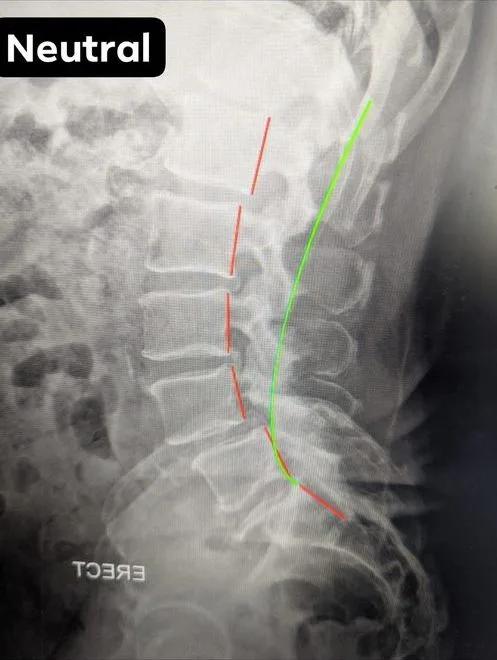
Neutral View
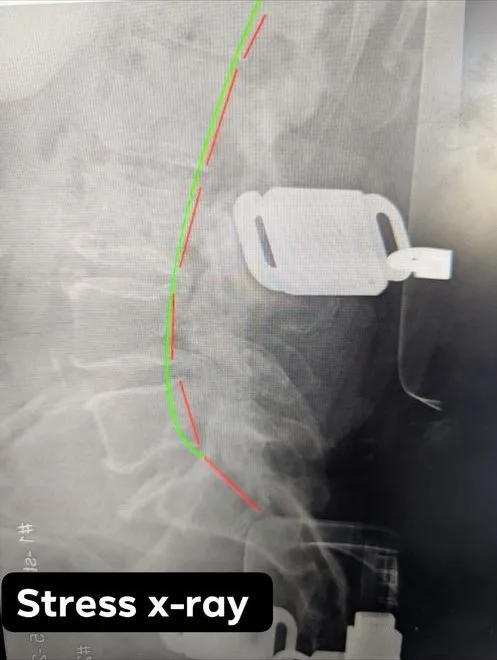
Assessing Motion & Stability
Neutral and stress (flexion-extension) radiographs from one de-identified case, shown to illustrate how segmental motion and stability are assessed. The views differ in position, not in time: they are not a before-and-after comparison and do not represent a treatment outcome. The measured change reported in the published 117-patient series is cited in the research section below.
The Conservative Structural Approach
When a case is appropriate for conservative care, a plan may include some — not necessarily all — of the following, chosen for the individual. Conservative care generally focuses on symptoms, stability, and function; it does not guarantee a permanent change in the slip.
- •Chiropractic adjusting and corrective positioning selected for the individual case.
- •Corrective traction and our structural correction process when indicated.
- •Exercise and stabilization to support the surrounding musculature.
- •Activity guidance and, where clinically appropriate, decompression.
- •Objective reassessment to review response and adjust the plan.
What People Commonly Try
Most people arrive having already tried at least one of these. Each has a legitimate place, and for many people with spondylolisthesis one of them is the right answer. The question is whether anything structural has been measured along the way.
Activity modification and rest
Where it helps: Often the right first step. Easing the activities that provoke symptoms can settle a flare-up and is sensible early on.
Its limit: It says little about what is driving the problem, and prolonged rest tends to reduce tolerance rather than build it.
Physical therapy
Where it helps: Strengthening, mobility and movement retraining with a qualified professional. Many people do well with it.
Its limit: Whether structural alignment is measured and re-measured varies by provider; progress is often judged mainly by symptoms and function.
Injections
Where it helps: Can calm inflammation around an irritated nerve or joint, sometimes enough to allow other care to proceed.
Its limit: The effect is usually temporary, repeat use is limited, and the structure is unchanged afterwards.
Medical referral and evaluation
Where it helps: Essential when there are red flags, progressive neurological findings, or a possible non-mechanical cause. We refer to the appropriate physician when the examination points that way.
Its limit: A medical opinion is a diagnosis, not a plan; it does not by itself tell you what the structure is doing or how to change it.
Surgery
Where it helps: The right answer for specific presentations, including progressive neurological deficit, instability, or a problem that conservative care cannot address.
Its limit: Most people with this condition do not need it, and a careful trial of conservative care is usually appropriate first where it is safe to do so.
None of this is an argument against those options. It is the reason we measure before recommending anything. How relief-focused care and structural correction differ.
How Optimus Approaches the Evaluation
The process is the same for spondylolisthesis as for any presentation we see, because it is designed to find out whether structure is part of your problem rather than to assume it is.
Complimentary Structural Consultation
A private conversation about your concerns, goals, previous care and whether this office is an appropriate fit. No examination, imaging or treatment takes place.
Paid structural examination
Orthopedic, neurological, movement and functional testing. The fee is explained before it is scheduled.
Objective measurements
Posture measured in millimeters and compared with normal reference values, so there is a baseline to re-measure against.
Imaging only when clinically warranted
Structural X-rays or stress views are taken only when the examination indicates them, and the reason is explained first.
Patient Recommendation Conference
The separate visit where your findings, our recommendations, the proposed plan and the fees are explained before you agree to anything.
Individualized recommendations
If structural correction is appropriate, a plan built around your own measured findings. If another evaluation is the better path, we say so.
Scheduled progress examinations
Re-examination at set points so change is documented, not assumed. If the measurements are not changing, the approach changes.
Comparative imaging only when clinically justified
Repeat images are taken to compare against the baseline only when there is a clinical reason to do so.
What the first visits involve, what to bring and how payment works are set out on the new patient page.
Not Sure Whether This Applies to You?
The complimentary structural consultation is the place to ask. It is a private conversation about your spondylolisthesis, what you have already tried and whether measuring your spine is a reasonable next step. No examination, imaging or treatment takes place, nothing is booked beyond it, and if another kind of evaluation is the better path we will say so.
Schedule a Complimentary Structural ConsultationWhat the Research Shows — and Its Limits
A 2026 case series published in the European Spine Journal is the largest published report to date on conservative reduction of lumbar anterolisthesis. It reviewed 117 patients with a slip greater than 4 mm who completed a multimodal Chiropractic BioPhysics® protocol — Mirror Image® chiropractic adjustments, Mirror Image® therapeutic exercises and Mirror Image® mechanical traction — over an average of roughly 43 visits across about 22 weeks.3
What it reported:
- • Mean anterior translation decreased from 8.26 mm to 3.96 mm.
- • By Meyerding grade: 6.10 mm to 2.50 mm at Grade I, 11.62 mm to 5.89 mm at Grade II, and 19.18 mm to 14.30 mm at Grade III — the last from only four cases.
- • SF-36 quality-of-life scores for bodily pain, physical functioning and the physical and mental summary components improved by margins the authors considered clinically important.
Why we present this carefully
- • It is a retrospective case series with no control group; the authors state it does not show causation.
- • Only patients who were compliant and completed care, with full before-and-after records, were included. The authors note this completer bias means results may appear more favourable than they would be in the general patient population.
- • The protocol was multimodal, so no single component — including traction — can be credited with the result.
- • There was no long-term follow-up, and the sample was small and non-randomised.
- • The authors call for larger prospective trials with control groups and long-term follow-up.
This is a meaningful addition to a thin evidence base. It is not a promise. We do not guarantee a reduction in your slip, and whether this approach is appropriate for you is a question your examination answers — not a question this study answers on your behalf.
Where the measured presentation is suitable, the traction component is described in more detail on our spinal decompression and corrective traction page. The measurement principles behind it are covered in Chiropractic BioPhysics® and why we measure rather than assume.
The Rest of the Evidence Base
It is important to be clear about the shape of this literature. Within the Chiropractic BioPhysics® research we have reviewed, there are no controlled trials for spondylolisthesis. Beyond the 2026 case series above, that material is small case series and single-patient reports. They describe what happened to particular patients. They cannot show that the care caused the change, and they are not a basis for predicting your result.
That statement is about this body of research, not about conservative care in general. Spondylolisthesis has been studied more widely than that — exercise and stabilisation approaches, for instance, have been examined in controlled trials outside the CBP literature, and we would not want you to read the line above as a claim that no such evidence exists. What we can say is what our own research library contains, and we list it because it is what exists there, not because it settles anything.
- Case series · n=3 · 2024
A published case series of 3 older adults with lumbar spondylolisthesis reported the average slip reduced from 14.5 mm to 4.2 mm with CBP care, with back pain falling from 7.3 to 1 out of 10 and the gains maintained more than a year later.
Limitations: 3 patients, no control, and CBP-affiliated authors. "Correction" here means *reducing* an excessive curve. On the urinary results: do not use this as a treatment claim for urinary dysfunction; at most mention it as an isolated case-series finding.
Fedorchuk 2024 - Case report · 1 participant · 2017
A published case report described a 69-year-old woman whose grade 2 L4–L5 spondylolisthesis measured 13.3 mm before and 2.4 mm after 60 CBP sessions over 45 weeks that included lumbar traction.
Limitations: X-ray result only. No post-treatment symptom data, so don't claim pain relief. One patient, no post-care follow-up. Slip measurement varies with positioning. CBP-practitioner authors.
Fedorchuk 2017 - Case report · 1 participant · 2020
A published case report described a 32-year-old man whose multiple lumbar retrolistheses were reduced on X-ray, and whose back disability fell from 34% to 0%, after CBP extension traction care, with stability at 13 months during infrequent (about twice-monthly) maintenance visits.
Limitations: Single patient with unusual anatomy (congenital fusion). CBP-affiliated authors; non-PubMed journal.
Oakley 2020 - Case report · 1 participant · 2020
A published case report described a 63-year-old woman whose X-rays showed less vertebral slippage at three lumbar levels after CBP adjustments, exercises and traction.
Limitations: Single patient; no measurements or pain data in the abstract; slip measurements vary with positioning; non-indexed journal.
Fedorchuk 2020
These summaries describe published research. They are not a promise of results, and individual results vary. Every study we cite, with its design and limitations, is listed on our research and evidence page.
Who May Be a Candidate
Conservative structural care is often reasonable for people with a lower-grade, stable slip whose examination does not show significant or progressive neurological loss, and who have not yet had an adequate trial of conservative care. The only way to know is a clinical evaluation.
Who May Not Be a Candidate
Some presentations are better served by medical or surgical evaluation first — for example, high-grade or clearly unstable slips, significant or progressive neurological deficits, or any of the urgent findings below. Not every case is appropriate for chiropractic care, and we will tell you directly if yours is not.
When to Seek Urgent Medical Care
Some symptoms need prompt medical or emergency attention rather than routine care. Seek evaluation right away for:
- • New bowel or bladder dysfunction, or numbness in the saddle region
- • Progressive leg weakness, or severe or rapidly worsening neurological symptoms
- • Major recent trauma, or fever with significant spinal pain
- • Known cancer history with new, severe spinal symptoms
These can suggest a fracture, infection, or cauda equina syndrome. This is general guidance, not a self-diagnostic checklist — when in doubt, seek medical care.
Frequently Asked Questions
Is spondylolisthesis serious?
It depends on the grade of the slip, its stability, and whether nerves are involved. Many low-grade cases are managed conservatively, while high-grade or unstable slips — or cases with progressive neurological symptoms — may need medical or surgical evaluation.
Can conservative structural care fix or reverse a spondylolisthesis slip?
Conservative care, including structural chiropractic care, generally focuses on symptoms, segmental stability, and function rather than guaranteeing a permanent reduction of the slip. We evaluate each case individually to determine whether a conservative approach is appropriate. Individual results vary.
What do standing and stress (flexion-extension) X-rays show?
Stress radiographs may help assess how the affected segment moves and whether there is dynamic instability. That information helps determine whether a conservative structural approach is appropriate for the individual case.
Do I need surgery for spondylolisthesis?
Not necessarily. Nonsurgical care is first-line for many patients. Surgery is typically considered when conservative care has not helped over several months, or when there are significant or progressive neurological findings.
When should I seek urgent medical care?
Seek prompt evaluation for new bowel or bladder dysfunction, numbness in the saddle region, progressive leg weakness, or severe or rapidly worsening neurological symptoms. These can indicate a serious problem such as cauda equina syndrome.
Research and References
Educational information on this page is consistent with the following authoritative references. These support general clinical background — the grading system, the role of stress radiographs, and conservative care as a common first-line approach — and are not presented as proof of any specific outcome.
- Margetis K, Gillis CC. Spondylolisthesis. StatPearls [Internet]. StatPearls Publishing; updated 2025. ncbi.nlm.nih.gov (peer-reviewed clinical reference)
- American Academy of Orthopaedic Surgeons (OrthoInfo). Adult Spondylolisthesis of the Low Back. orthoinfo.org (patient-education, major medical organization)
- Fedorchuk CA, Lightstone DF, Fedorchuk CG, Fernandez CJ, DeGeorge SM, Harrison DE. Improvement in physical and mental quality of life following reduction of lumbar spondylolisthesis using chiropractic BioPhysics® corrective spinal rehabilitation: a case series of 117 patients with lumbar anterolisthesis(es). Eur Spine J. 2026. doi.org (retrospective case series, no control group)
Related Reading
Learn more about Dr. Gareth Bury, DC.
Individual results vary. A clinical evaluation is required to determine candidacy for structural correction. Outcomes depend on factors including severity, chronicity, adherence, and overall health.