
Spinal Decompression in Greensburg, PA
Non-surgical decompression is one possible component of care — not a diagnosis and not a solution on its own. We establish what is actually driving your symptoms first, then determine whether decompression is reasonable for you.
Why People Come Across Decompression
If you have persistent neck or low-back symptoms that are thought to involve a disc — particularly where pain travels into an arm or leg — you have probably encountered “spinal decompression” as an option somewhere between physical therapy and surgery. It is a non-invasive, table-based procedure, and for the right presentation it can be a reasonable thing to try. It is one of the interventions available at our office in Greensburg, PA.
The part that matters more, and gets discussed less, is what comes before it. Establishing what is actually producing your symptoms has to come first. Decompression is a mechanical intervention aimed at a mechanical problem; recommending it before the problem is characterized is putting the equipment ahead of the examination.
What Is Non-Surgical Spinal Decompression?
Decompression is a form of mechanical traction. You lie clothed on a motorised table, secured with a harness, and the table applies a controlled, computer-regulated distraction force to a targeted region of the spine, usually cycling between tension and relaxation across a session. The intent is to modify how that segment is loaded and to temporarily reduce mechanical stress on the disc and surrounding tissues.
That is a deliberately modest description. Decompression is sometimes marketed with claims about creating negative pressure inside the disc and drawing herniated material back into place. Those mechanisms are proposed rather than firmly established in living patients, and we do not make that claim. What can reasonably be said is that a controlled distraction force changes loading on the segment while it is applied.
What May Be Evaluated for Decompression
Presentations where decompression is sometimes considered as part of a plan include:
- • Herniated disc and bulging disc presentations
- • Disc degeneration with mechanical symptoms
- • Sciatica and radiating leg symptoms where a disc-related contributor is plausible
- • Certain cervical disc presentations, including some with arm symptoms
- • Mechanical low back pain where it is clinically appropriate
Carrying one of these diagnoses does not automatically make someone a decompression candidate. A disc finding on a scan is common in people without symptoms, a diagnosis does not describe how a particular spine behaves under load, and some of these presentations are better served by something else entirely. Whether you are a candidate is established by examination at our Greensburg, PA office, not by the diagnosis you arrive with.
Decompression Is Not the Diagnosis
Two people can describe almost identical symptoms — low back pain with discomfort down one leg — and have genuinely different problems underneath. One may have a disc-related nerve root irritation. Another may have narrowing around the nerves, a joint-driven pattern, referred pain, or a contributor that is not mechanical at all. The same intervention is not automatically right for both.
Before decompression is discussed, the New Patient Structural Examination may include:
- •History: how the symptoms behave, what changes them, and how they have progressed.
- •Orthopedic and neurological examination when appropriate: including strength, reflexes and sensation where symptoms suggest nerve involvement.
- •Computerized posture analysis: objective postural measurement rather than visual impression.
- •X-rays when clinically indicated: used where they will meaningfully inform care — see what structural X-ray analysis can and cannot show.
- •Structural measurements: alignment compared against defined biomechanical reference values.
- •Review of existing MRI or other imaging where you already have it and it is relevant. We do not perform MRI in our office, and advanced imaging is not routinely required.
How Decompression Fits Into Structural Correction
Where decompression is appropriate, it is one tool inside a broader plan rather than the plan itself. Depending on findings, care may incorporate specific chiropractic adjustments, Chiropractic BioPhysics® principles, corrective traction, posture rehabilitation, corrective exercise, decompression, and scheduled reassessment. Not every patient receives every component — the combination is selected for the individual.
The conceptual distinction is worth being precise about:
- • Decompression primarily addresses mechanical loading at a segment and disc-related factors, while the force is applied.
- • Structural correction asks a different question: whether measurable postural or spinal alignment factors are also contributing to that abnormal loading in the first place.
They are complementary rather than interchangeable, and neither is assumed to be necessary. See our evaluation and correction process for how a plan is actually built.
What the Evidence Does and Does Not Show
We would rather tell you this directly than have you find it elsewhere. The published evidence for traction and decompression is limited and mixed. A Cochrane systematic review of traction for low back pain with or without sciatica concluded that traction, alone or combined with other treatments, has little or no impact on pain intensity, functional status, global improvement or return to work, and that the available studies were small and at moderate to high risk of bias.1 For neck pain with or without radiculopathy, a separate Cochrane review concluded the literature neither supports nor refutes the efficacy of traction.2
That is precisely why decompression is not positioned here as a primary or standalone solution, is not offered to everyone who presents with back pain, and is not sold as a package of predetermined visits. Where it is used, it is because the examination suggests it is reasonable for that person — and the response is measured rather than assumed.
A Different Application: Corrective Traction for Spondylolisthesis
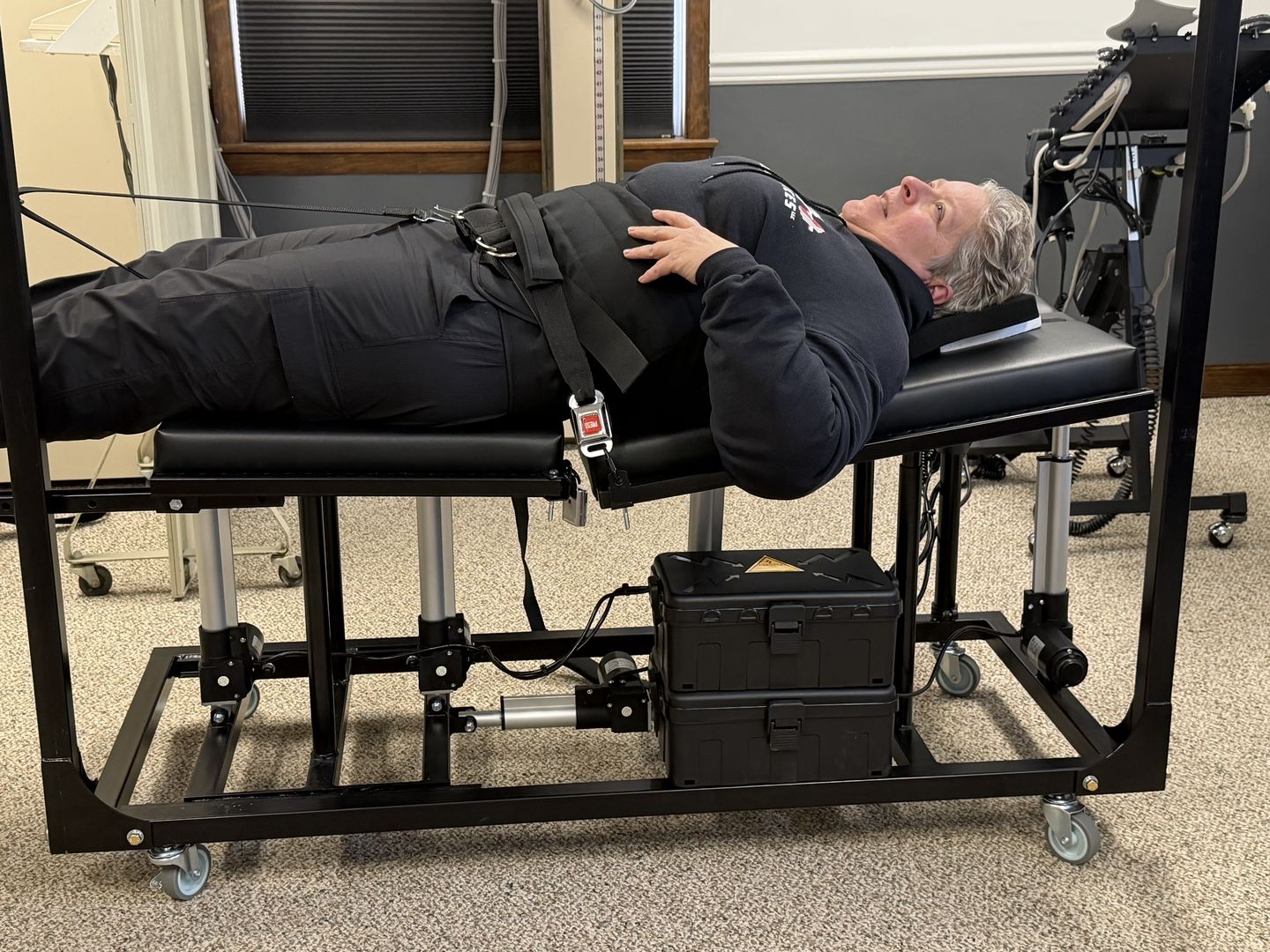
Everything above concerns generic disc decompression. There is a separate application worth distinguishing, because it is not the same set-up and the evidence is not the same either. Where examination and clinically indicated imaging identify a lumbar spondylolisthesis — a vertebra translated forward relative to the one below it — traction may be configured specifically to address that measured translation, rather than simply to unload a disc.
The positioning differs accordingly. The patient lies supine with the knees supported, and a controlled anterior-to-posterior force is applied through the pelvis in the direction opposite the measured shift — a Mirror Image® principle — rather than distracting the spine lengthwise.
What the 2026 research reported
A 2026 case series in the European Spine Journal reviewed 117 patients with lumbar anterolisthesis greater than 4 mm who completed a multimodal Chiropractic BioPhysics® protocol — Mirror Image® chiropractic adjustments, Mirror Image® therapeutic exercises and Mirror Image® mechanical traction — over an average of roughly 43 visits across about 22 weeks. Mean anterior translation decreased from 8.26 mm to 3.96 mm. Reported changes by Meyerding grade (the standard grading of how far the vertebra has slipped) were 6.10 mm to 2.50 mm at Grade I, 11.62 mm to 5.89 mm at Grade II, and 19.18 mm to 14.30 mm at Grade III — the last based on only four cases. SF-36 quality-of-life scores for bodily pain, physical functioning and the physical and mental summary components also improved by margins the authors classed as clinically important.4
How much weight this should carry
This is genuinely interesting research, and it is also important to read it accurately:
- • It is a retrospective case series with no control group. The authors state plainly that it does not show causation.
- • Only patients who were compliant and completed care, with full before-and-after records, were included. The authors note this completer bias means the results may appear more favorable than they would be in the general patient population.
- • The intervention was multimodal — adjustments, exercises and traction delivered together. Nothing in it can be attributed to traction or decompression on its own.
- • There was no long-term follow-up, and the sample was small and non-randomized.
- • The authors call for larger prospective trials with control groups and long-term follow-up.
So: encouraging and worth knowing about — but not evidence that this will happen for you, and not a basis for us to promise a reduction in your slip. It also says nothing about generic disc decompression, which is a different intervention aimed at a different problem.
Whether this approach is appropriate depends on your examination and imaging — grade, stability, neurological findings and your overall presentation. Not every person with spondylolisthesis is a candidate. Our spondylolisthesis evaluation page explains how candidacy is assessed, and why we measure rather than assume.
Wondering whether decompression applies to you?
The complimentary structural consultation is a 15-minute conversation about your concerns and whether an examination makes sense. No examination takes place, and nothing is booked beyond it unless you decide.
Or call 724-672-3794
Who May Not Be a Candidate
Decompression is not suitable for everyone. Situations that may make it inappropriate, or require medical clearance first, include:
- • Spinal fracture, or significant or suspected instability
- • Severe or progressive neurological deficit
- • Significant osteoporosis or compromised bone quality
- • Known or suspected malignancy, or spinal infection
- • Certain post-surgical situations, including spinal hardware or fusion
- • Pregnancy, and some vascular or other medical conditions
This is not an exhaustive list of medical clearance criteria, and it is not a substitute for an individual assessment. Some people in these categories can still be helped by other approaches; others need medical evaluation first. The only way to establish which applies to you is an individual evaluation. Individual results vary.
When Symptoms Need Urgent Medical Evaluation
Some findings warrant prompt medical assessment rather than routine decompression care. Seek medical evaluation promptly for:
- • New or progressive motor weakness
- • New problems controlling your bladder or bowels
- • Numbness in the saddle or groin area
- • Spinal symptoms following major trauma
- • Severe spinal pain with fever or signs of systemic illness
New bladder or bowel dysfunction together with saddle numbness and progressive weakness can indicate cauda equina syndrome, a medical emergency. This is general guidance, not a self-diagnostic checklist — when in doubt, seek medical care.
How We Decide Whether to Use It
Our principle is We Measure. We Correct. We Prove It. Applied here, that means treatment selection follows the examination and the objective findings — not a default pathway where everyone with back pain ends up on the same table.
Practically: we measure before recommending, we explain what we found and what we are uncertain about, we use decompression only where the findings support it, and we reassess objectively so that continuing, changing or stopping is a decision based on measurement. “Prove it” means documenting change through reassessment — not promising a result. See why objective measurement matters and how corrective care differs from symptom relief.
Frequently Asked Questions
What is spinal decompression?
Non-surgical spinal decompression is a form of mechanical traction. A motorised table applies controlled, computer-regulated distraction to a targeted region of the spine with the intent of temporarily reducing mechanical loading on the disc and surrounding tissues. It is a conservative, non-invasive procedure, and it is one possible component of care rather than a treatment in its own right.
Does spinal decompression hurt?
It is generally described as a slow, gentle stretch rather than a painful procedure, and you remain clothed and in control throughout. Some people notice temporary soreness afterwards, much like after new exercise. If a session provokes or worsens symptoms, that is important information and the plan should be reviewed rather than pushed through.
Can spinal decompression help a herniated disc?
It may be considered as part of a plan for selected disc-related presentations, but the evidence base is limited and mixed. Whether it is reasonable for you depends on your examination findings, not on the diagnosis alone.
Is spinal decompression the same as traction?
Both apply a controlled distraction force, and in the decompression literature the terms are often used together. Clinically, though, we keep two things separate. Mechanical spinal decompression uses a motorised, computer-controlled table to distract a specific disc level, and its aim is disc-related. Lumbar and thoracic structural traction is a different intervention with a different aim — changing measured spinal alignment — and it is set up and progressed differently. Research on one is not evidence for the other, and we do not present it that way.
How many spinal decompression sessions do I need?
There is no set number, and we do not publish a predetermined visit count. Frequency and duration depend on your diagnosis, severity, how you respond, your goals, and what the examination finds. Any plan should be reassessed objectively, and changed or stopped if it is not producing the response expected.
Who should not have spinal decompression?
It is not appropriate for everyone. It is not appropriate for everyone. See Who May Not Be a Candidate above; an individual evaluation is required., known or suspected malignancy or spinal infection, and certain post-surgical situations such as spinal hardware or fusion. Pregnancy and some vascular conditions also require individual assessment. This is not an exhaustive list — an individual evaluation is required.
Do I need an MRI before spinal decompression?
Not necessarily. We do not perform MRI in our office, and advanced imaging is not routinely required. Where you already have an MRI or other imaging, we will review it as part of your evaluation. Where the history and examination suggest it is needed, we refer for appropriate imaging or medical assessment rather than proceeding without it.
Research and References
These references are cited for general background on the evidence for traction and on interpreting imaging findings. They are included because they reflect the state of the evidence honestly — not as proof of any specific outcome.
- Wegner I, Widyahening IS, van Tulder MW, et al. Traction for low-back pain with or without sciatica. Cochrane Database of Systematic Reviews. 2013, Issue 8. Art. No.: CD003010. doi.org (systematic review)
- Graham N, Gross A, Goldsmith CH, et al. Mechanical traction for neck pain with or without radiculopathy. Cochrane Database of Systematic Reviews. 2008, Issue 3. Art. No.: CD006408. doi.org (systematic review)
- Brinjikji W, Luetmer PH, Comstock B, et al. Systematic literature review of imaging features of spinal degeneration in asymptomatic populations. AJNR Am J Neuroradiol. 2015;36(4):811–816. doi.org (systematic review)
- Fedorchuk CA, Lightstone DF, Fedorchuk CG, Fernandez CJ, DeGeorge SM, Harrison DE. Improvement in physical and mental quality of life following reduction of lumbar spondylolisthesis using chiropractic BioPhysics® corrective spinal rehabilitation: a case series of 117 patients with lumbar anterolisthesis(es). Eur Spine J. 2026. doi.org (retrospective case series, no control group)
What to Expect at Optimus Spine & Posture
If you are considering decompression, the decision is made by examination, not by booking a table. The first visit at our Greensburg, PA office is a complimentary 15-minute structural consultation: a conversation about your symptoms, prior care and any imaging you already have, with no examination. If measuring your spine is a reasonable next step, the New Patient Structural Examination (the comprehensive structural examination) is a separate, paid service: posture measured against reference values, orthopedic, neurological and functional testing, and X-rays only when clinically indicated. The findings are then reviewed at the Patient Recommendation Conference, the separate visit where findings, recommendations, the proposed plan and fees are explained before you agree to anything. If care begins, progress is reassessed at set points. More on what the first visits involve.
Related Reading
- • Herniated disc: imaging, red flags and candidacy
- • Bulging disc
- • Sciatica and radiating leg pain
- • Back pain evaluation in Greensburg, PA
- • Structural correction: how we measure and correct
- • Research and evidence: what the studies show, and what they do not
- • Why we measure before we recommend
- • Understanding spondylolisthesis measurements
- • What happens as a new patient
- • Structural correction chiropractic in Greensburg, PA
Learn more about Dr. Gareth Bury, DC.
Individual results vary. A clinical evaluation is required to determine whether spinal decompression or structural correction is appropriate for you. Outcomes depend on factors including the cause, severity, how long it has been present, adherence, and overall health. This page is educational and is not a substitute for medical evaluation.
Commonly Evaluated
- • Herniated and bulging discs
- • Disc degeneration with mechanical symptoms
- • Radiating leg or arm symptoms
- • Certain cervical disc presentations
- • Mechanical low back pain
Serving Greensburg and the wider Westmoreland County area.
What Decompression Can and Cannot Do
- • It applies controlled, measured distraction to a targeted region, as one component of a plan built from your findings
- • It does not repair or re-seat a disc
- • It does not remove the need for surgery where surgery is indicated
- • It is not appropriate for everyone, and results are neither predictable nor permanent
Find Out If You Are a Candidate
A complimentary structural consultation is a conversation about your symptoms, your history and the care you have already tried, so we can decide together whether a comprehensive structural examination is the appropriate next step. The examination, not the consultation, establishes whether structural factors are involved and whether decompression or structural correction is an option for you.
Or call 724-672-3794